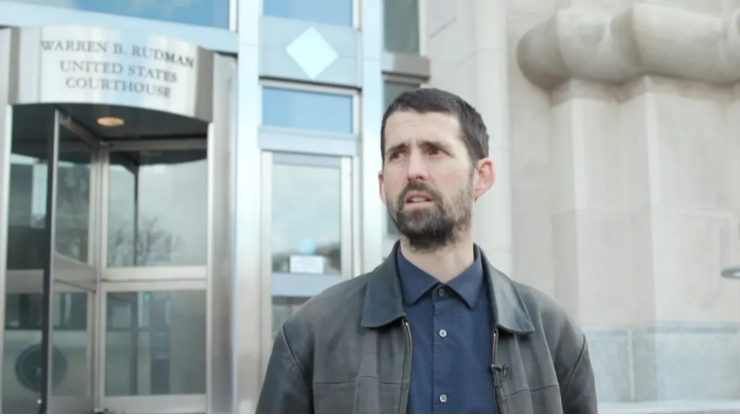
Ian Freeman
Federal — District of New Hampshire
Ian Freeman
Click to enlarge
SENTENCE
96 months (8 years) federal prison, 2 years supervised release, $40,000 fine, $3,502,708.69 restitution to 29 victims, forfeiture of seized assets including over 100 Bitcoin
CHARGES
Conspiracy to operate an unlicensed money transmitting business Operation of an unlicensed money transmitting business Conspiracy to commit money laundering Money laundering Tax evasion (four counts)

THEIR STORY

Ian Freeman was born Ian Bernard around 1980 and grew up on Florida’s Gulf Coast. In 2002, he co-founded Free Talk Live, a nightly call-in radio program that grew into one of the most widely syndicated libertarian shows in the country, airing on over 100 stations. Many early Bitcoin adopters credit Free Talk Live with introducing them to cryptocurrency.

In 2006, Ian moved to Keene, New Hampshire, as one of the earliest participants in the Free State Project. He became one of the most recognizable libertarian activists in the state.

Beginning in 2014, Ian started selling Bitcoin through peer-to-peer transactions and later installed Bitcoin vending kiosks. He operated his exchange as a ministry of the Shire Free Church. Between 2016 and 2019, he facilitated over 3,000 transactions for more than 2,000 customers, earning over $1 million in fees. He operated openly and kept records including photographs of customers’ identification.

Ian did not register with FinCEN as a money services business. He believed the requirement was unconstitutional. He opened bank accounts under church names and instructed customers to describe deposits as church donations. From 2016 to 2019, he did not file federal tax returns. These were deliberate acts of civil disobedience — public expressions of his deeply held beliefs about the illegitimacy of the regulatory state.

The FBI began investigating Ian in 2017. Agents had sufficient evidence to intervene. They waited until March 2021 to raid his home as part of the “Crypto Six” case. Four co-defendants pleaded guilty to a single count of wire fraud each. Ian was the only defendant to go to trial.

At trial in December 2022, prosecutors presented evidence that Ian’s exchange processed over $10 million in funds that were proceeds of romance scams targeting elderly victims. Ian’s defense, led by attorney Mark Sisti, argued that Ian was not a scammer, had no connection to those committing fraud, and that the banks processing the same deposits performed no due diligence at all. In one instance, an undercover agent posing as a heroin dealer approached Ian directly and was refused service — the agent then used an unattended Bitcoin kiosk to convert cash anyway.

The jury convicted on all remaining counts. On October 2, 2023, Judge Joseph Laplante sentenced Ian to 96 months. He was ordered to pay $3.5 million in restitution to 29 victims and forfeit seized assets including over 100 Bitcoin.

Ian’s appeal to the First Circuit was denied July 29, 2025. The Supreme Court denied certiorari February 23, 2026. Ian Freeman’s only remaining path to freedom is a presidential pardon or commutation.

WHY THEY DESERVE A PARDON

Ian Freeman is a libertarian radio host, peace activist, and minister who dedicated his life to free speech and financial sovereignty. He co-founded Free Talk Live, one of the most widely syndicated libertarian radio programs in America. He moved to Keene, New Hampshire, as one of the earliest participants in the Free State Project. He became one of the first and most visible Bitcoin advocates in New England, installing Bitcoin vending machines, convincing local businesses to accept cryptocurrency, and facilitating thousands of peer-to-peer transactions. He saw Bitcoin as a ministry — a path to financial freedom for ordinary people. For all of that, Ian is serving 8 years in federal prison. The government’s case was that scammers — romance scammers targeting elderly victims — directed their victims to purchase Bitcoin through Ian’s exchange. Ian did not know the scammers. He had no relationship with them. He never communicated with them. When he became aware that some transactions looked suspicious, he implemented his own screening questions — something the banks handling the exact same deposits never did. The government had Ian under surveillance since 2017. They had enough evidence to arrest him then. They chose to wait three more years while additional victims were defrauded — victims the government could have protected by acting sooner. The original indictment contained 25 charges. Seventeen were dropped before trial. The trial judge later overturned one money laundering conviction. The sentencing guidelines called for 17 to 22 years. The judge imposed 8 — less than half — acknowledging the significant departure. But 8 years remains a devastating sentence for a nonviolent offender whose core conduct was operating a financial business without a license. Ian’s appeal to the First Circuit was denied July 2025. The Supreme Court denied certiorari February 2026. All legal avenues are exhausted. His only remaining path to freedom is executive clemency. The system that prosecuted Ian Freeman is the same system that prosecuted Roger Ver, Roman Storm, Roman Sterlingov, Keonne Rodriguez, William Lonergan Hill, and Ray Youssef. Each case demonstrates a government that treats cryptocurrency itself as suspicious and punishes those who build, promote, or facilitate it. The inconsistency in how these cases are resolved — the wildly different outcomes for similar conduct — is not evidence that some defendants deserve more sympathy than others. It is evidence that the system itself is broken. MACS advocates for all of them.

WATCH